
A few days ago, news broke of the signing of a major new free trade agreement between the European Union and India, aimed at strengthening economic and political ties between “two giants,” as Ursula von der Leyen called them, at a time of heightened international tensions.
Beyond the “historic” significance of this agreement, which comes after decades of negotiations, this free trade agreement can bring many potential benefits to European producers: the agreement provides for the reduction of tariff and non-tariff barriers, with a cut of over 90% of existing duties on exports to India.
India, which is truly an economic giant: with a population of 1.45 billion and an annual GDP of €3.4 trillion, is the world’s fourth-largest economy.
In 2024, exports from the EU to India amounted to €75 billion, of which €48.8 billion in goods and €26 billion in services. The new agreement is expected to double this volume.
Which sectors will benefit most? Currently, exports to India are broken down as follows:
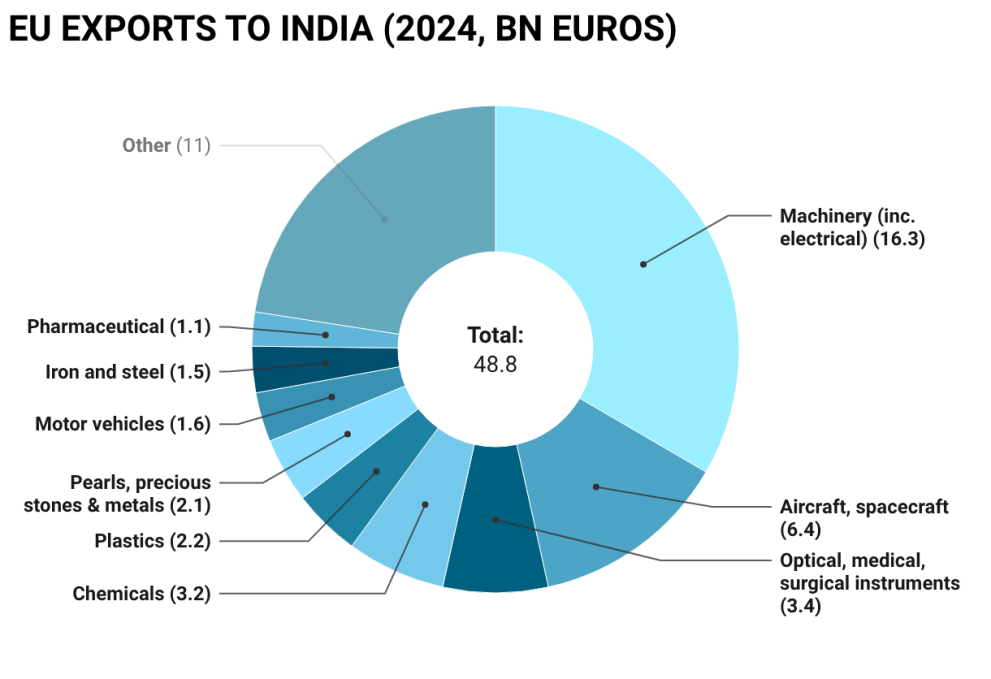
These percentages could vary considerably.
Wine and spirits exports, currently heavily penalized by 150% tariffs, will see tariffs progressively decrease over the coming years to around 20%. Tariffs on olive oil will drop from the current 45% to 0% in five years. These are just a few examples of the potential benefits for the agri-food sector.
Regarding other sectors, India will gradually reduce customs tariffs on cars imported from the European Union from 110% to 10%, and tariffs on machinery, chemical products, and pharmaceuticals will be largely eliminated. These are highly significant sectors for Italian exports.
More details are available here: